+33 483 262 230

For several years now, we’ve been offering a wide range of washi tea caddies in our catalog. But what is this paper that every tea drinker has heard of?
What is washi paper?
Japanese paper, known as washi paper, is of superior quality to traditional Western paper. Indeed, the main characteristic of washi paper is that it can be wetted and brushed (with care, of course). The long fibers that make up the paper also give it excellent strength. Japanese papers have had a special place in Japanese culture for centuries, whether for calligraphy or decoration.
How washi paper is made
In Japan, washi paper is made from the bark fibers of the mulberry tree, or kôzo. The branches are harvested in November. Numerous manipulations are required to recover the fibers from mulberry bark. Here are the various stages involved in extracting the fibers used to make Japanese paper:
- steamed
- dried
- écorchée
- scraped
- sun-bleached
- washed, boiled
- sorted
- hunt
- sheared.
It’s easy to see why washi paper is of such high quality, and why it’s so famous! This process takes 2 to 3 months over the winter, until February. Then, in order to work the paper, a vegetable glue made from the roots of a plant in the hibiscus family is applied. This enables the fibers to remain suspended in the large Japanese paper forming frames, and prevents the fibers from disintegrating as they dry.


Decorating washi paper
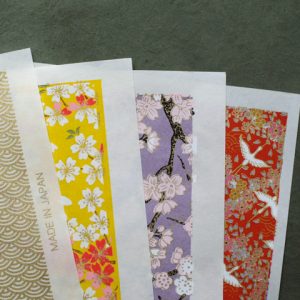 There are two ways of decorating Japanese paper. The first uses stencils, while the second is screen printing. Stencilled sheets are called Katazome. Stencils are made from several sheets of laminated Japanese paper, then impregnated with green persimmon juice and smoked to make them waterproof. They are then cut to the desired pattern. Sublimation-decorated washi papers are called Choyogami. These are the papers we use to personalize our washi tea caddies. The advantage of screen printing is that it enables a high ink deposit for intense color. As a general rule, each screen printing frame is used to apply one color of the motif. It is therefore necessary to make as many passes as there are colors, washi papers having from 2 to 10 colors per sheet.
What about our washi tea caddies?
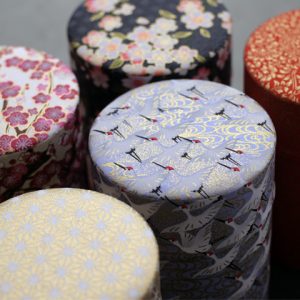 For almost 10 years, we’ve been offering superior quality tea caddies covered in Japanese paper. These washi tea caddies are decorated from large sheets measuring around 70 by 90cm, which we cut precisely and glue by hand in our workshop in northern France. Over the years, we’ve acquired the techniques needed to offer top-quality tins, with attention to detail and a focus on the handmade having always been our policy.